
Understanding Instant Search
Sat, 06/09/2007 - 16:37 — Ciprian
 Instant Search is one of the most useful new tools included in Windows Vista. It allows users to search and find everything on their computer: applications, e-mail messages, documents, music, photos and any other types of content. You can find Instant Search almost anywhere within the operating system: in the Start Menu, in the Control Panel, in every Explorer and also in other programs like Windows Media Player or Windows Photo Gallery.
In order to return results quickly, Instant Search needs to build an index with the content of your computer. By default, Instant Search indexes only a small number of folders such as the Start Menu, the names of the files that have been opened, the Documents folder, and the user's e-mail. It can also be configured to index only the type of content and the locations chosen by the user.
Instant Search is contextual and it shows results based on your current activity. This is why it will display different results depending on the location where you make the search. Even though, in theory, contextual search is not very complicated, some people will need some time to get used to it. This is why, in this article, we will try to explain how Instant Search works.
Search directly from the Start Menu
If you open the Start Menu you will notice that you have two options: you can use the search box placed immediately above the Start Menu button or you can click on the Search shortcut.
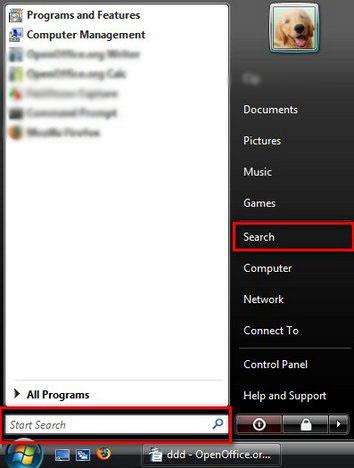
If you type a search query in the search box above the Start Menu button, Windows Vista will search for programs, files located anywhere in indexed locations (which include your personal folder, e‑mail, and offline files) and websites stored in your browser's history. The programs (applications) are returned first because this search box was designed as an alternative to browsing and clicking through all the folders and shortcuts in the Start Menu.
It takes a while to get used to it, but you will learn to love it and you will use it all the time.

As you can see in the above screenshot, when i typed the word "windows" the search results where split into categories. First, Windows Vista returned the list of applications containing the word "windows" in their name, then it returned a list of websites and after that a list of files matching my query.
The use of the Search shortcut from the Start Menu is a very good choice when you want to search for content placed in an unknown location. If you use the Advanced Search option you can search through all your computer and not only in the indexed locations. Also you can define search filters by using multiple criteria such as file size, author, tags and so on.

Search the Control Panel
The search box found in the Control Panel can be used only to search for applets. It allows you to quickly find shortcuts to configuration options.

For example, if you type the word "security", Windows Vista will quickly load shortcuts to different applets that allow you to configure aspects related to the security of your system.

This search box is also very useful for users that have trouble finding their way through the new Control Panel. Instead of losing time clicking through all the options and menus, you just type what you want to do and Windows Vista will show all the available options.
Search while browsing through your computer
The search box from Windows Explorer is very useful for finding content that you know is stored somewhere in a particular folder. For example, if you need to find a file stored in subfolder of your Documents folder, you just browse to your Documents folder and type the first letters of the file you want to find. Windows Vista will quickly go through all the subfolders and return the files that have a name containing those letters.

Instant Search for Windows applications
We mentioned in the beginning of this article that Instant Search can also be found in several applications such as Windows Media Player or Windows Photo Gallery. When you launch an application that uses Instant Search, the returned search results are only content related to that specific application. For example, if you type a word in the Windows Media Player search box, the search results will be tracks or albums, while Windows Photo Gallery will return pictures and photo albums matching your search term.

Related articles:
How to improve Instant Search
How to customize the Start Menu search box
How to enable Natural Search and how to use it
Recommended articles:
Advanced search techniques
Windows Search Advanced Query Syntax

This work is licensed under a Creative Commons Attribution-Noncommercial 3.0 License.
Microsoft, Windows and the Windows logo are either registered trademarks or trademarks of Microsoft Corporation in the United States and/or other countries. Microsoft Corporation in no way endorses or is affiliated with www.vista4beginners.com.
All other products mentioned are registered trademarks and/or trademarks of their respective companies.
Comments
Vista search
This article has no mention of how to find a document CONTAINING a specific word. To me this is the feature of the old search that I used the most. I know I can't blame the author for the design of search. But I can blame them for not including the most basic operation.
Restrict Results
I store hundreds of emails. I can search a specific word/term, but the results include emails without the term as well as with the term. I still have to open the mails and search thru them to find out if the term is there. I've been searching internet for a few days to find out how to bring back finite results, how to exclude emails without the term, but have found nothing. Is that feature gone in Outlook 2007? I'm so frustrated!!!
Vista search
I totally agree, it is quite impossible to find a file (with a known file-extension) containing a specific word or phrase with the new Vista search. This is one of the main reasons I am thinking of ditching Vista. It may be useful for people with few files or less advances uses but not on a network with lots of files and lots of versions of a file. Is it possible to implement the old fashioned - but efficient - search facility from XP?
Usefull article
I'm a new Vista user and I found this article very usefull. I'm an experienced XP user, but different Search options and locations in Vista had confused me a lot. Now I'm going to read the related articles "How to improve Instant Search" and "How to customize the Start Menu search box". Thank you.
Vista Search
My search appears to have been taken over by Google search - is this better. I too am fustrated by the search tool I liked the old one you could search by known extensions by typing *.doc for example you could also search for a particular word (probably my favourate feature). I intensly dislike the new system I hope windows 7 is better but I doubt it. Are there any free apps that will allow me to do this? I could find anything on XP but not on Vista.
windows Vista search
I can find stuff on my XP, but not on Vista. The search window is not large enough, no matter how I try to narrow the search. I can't find my oldest or newest photos or my powerpoint from office 2007. I used to be able to search for .xls or ppt on XP, but that doesn't work on Vista.
Post new comment